What Your Vulnerability Scanner Doesn't Tell You
If your organization runs regular vulnerability scans, you are already doing something right. They help identify outdated software, missing patches, exposed services, and other known security issues before attackers can take advantage of them. But a clean vulnerability scan does not necessarily mean you are secure.
Key Takeaway
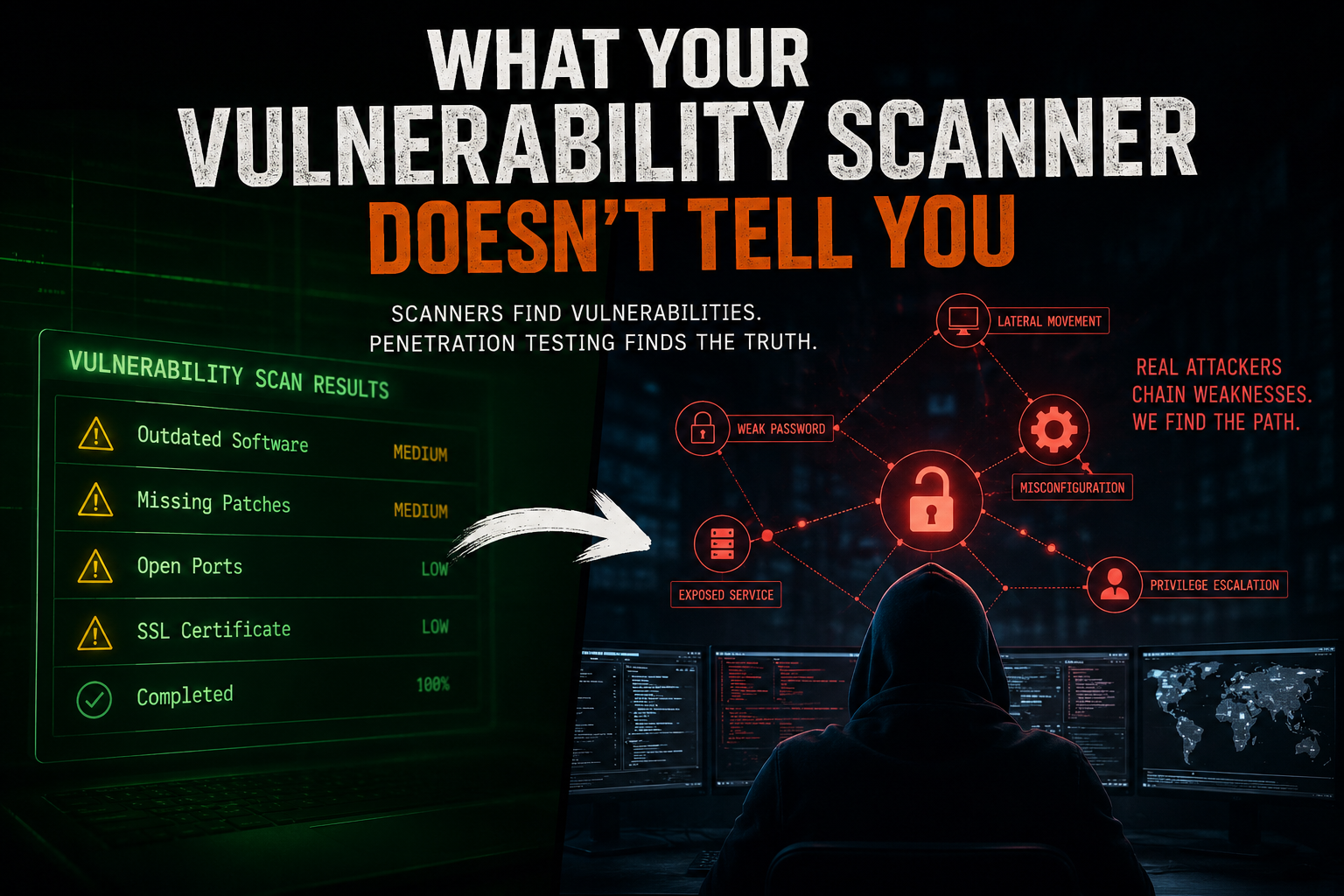
Vulnerability scanners are useful, but they answer whether a known vulnerability is present. Penetration testing asks how an attacker could actually get in.
Vulnerability scanners are great, but they are only one piece of the puzzle
Think of a vulnerability scanner like the warning lights on your car's dashboard. If the check engine light comes on, you know something needs attention.
What it does not tell you is whether you are about to break down on the highway or whether it is just a loose gas cap.
Security scanners work the same way. They point out missing patches, outdated software, weak SSL/TLS settings, open ports, known vulnerabilities, and common misconfigurations.
That is incredibly valuable information. But a scanner is not trying to think like an attacker. It is matching what it finds against a database of known issues.
Attackers do not see individual vulnerabilities
One of the biggest differences between a vulnerability scan and a penetration test is perspective.
A scanner looks at one issue at a time. An attacker looks at everything.
Maybe there is a forgotten admin account, a weak password policy, an exposed remote service, and a server that has not been patched.
By themselves, none of those may seem like a huge deal. Put them together, though, and suddenly an attacker has a path into your network.
That is exactly what penetration testing is designed to uncover.
Related Service
Learn more about SecureProbe penetration testing services →Not every medium risk is actually medium
If you have ever looked at a vulnerability report, you have probably seen dozens of findings labeled Low, Medium, or High.
Those ratings are helpful, but they do not always tell the whole story.
Imagine two companies with the exact same vulnerability. One system is tucked away on an internal network that almost nobody can reach. The other is exposed to the internet and connected to sensitive customer data.
Same vulnerability. Completely different level of risk.
Context matters. A good penetration test does not just tell you what is vulnerable. It tells you what actually matters.
The human element still matters
Automated tools are fast. They are consistent. Every organization should be using them.
But they do not improvise. They do not try different attack paths. They do not notice that someone accidentally left administrative access open or that two harmless-looking issues become dangerous when combined.
A penetration tester does.
The goal is not just to find vulnerabilities. It is to understand how someone could realistically use them.
The best security programs do not choose one or the other
This is not an either-or decision. The strongest security programs use both vulnerability scanning and penetration testing.
Vulnerability scans help you keep up with routine maintenance.
Penetration tests answer a much more important question: if someone targeted us today, how far could they actually get?
That is a question no scanner can answer on its own.
Final thoughts
Technology does a great job of finding known problems. But cybersecurity is not just about known problems. It is about understanding how those problems fit together.
That is why organizations continue to invest in penetration testing even when they are already running regular vulnerability scans.
At SecureProbe, we use both automated tools and manual testing to identify real attack paths, validate risk, and provide practical recommendations that help you strengthen your defenses, not just generate another report.
If you have only been relying on vulnerability scans, it might be time to take the next step and see your environment the way an attacker would.
Real-World Risk
Attackers do not treat findings as isolated tickets. They chain weak passwords, exposed services, forgotten accounts, and misconfigurations into realistic paths toward access.
What scanners often miss
Related Articles
Need help validating real-world risk?
SecureProbe provides penetration testing, vulnerability assessment, and attack surface analysis services designed to identify practical security risks and provide clear remediation guidance.
Request an Assessment