Patch Window? What Patch Window? How AI Broke Vulnerability Management
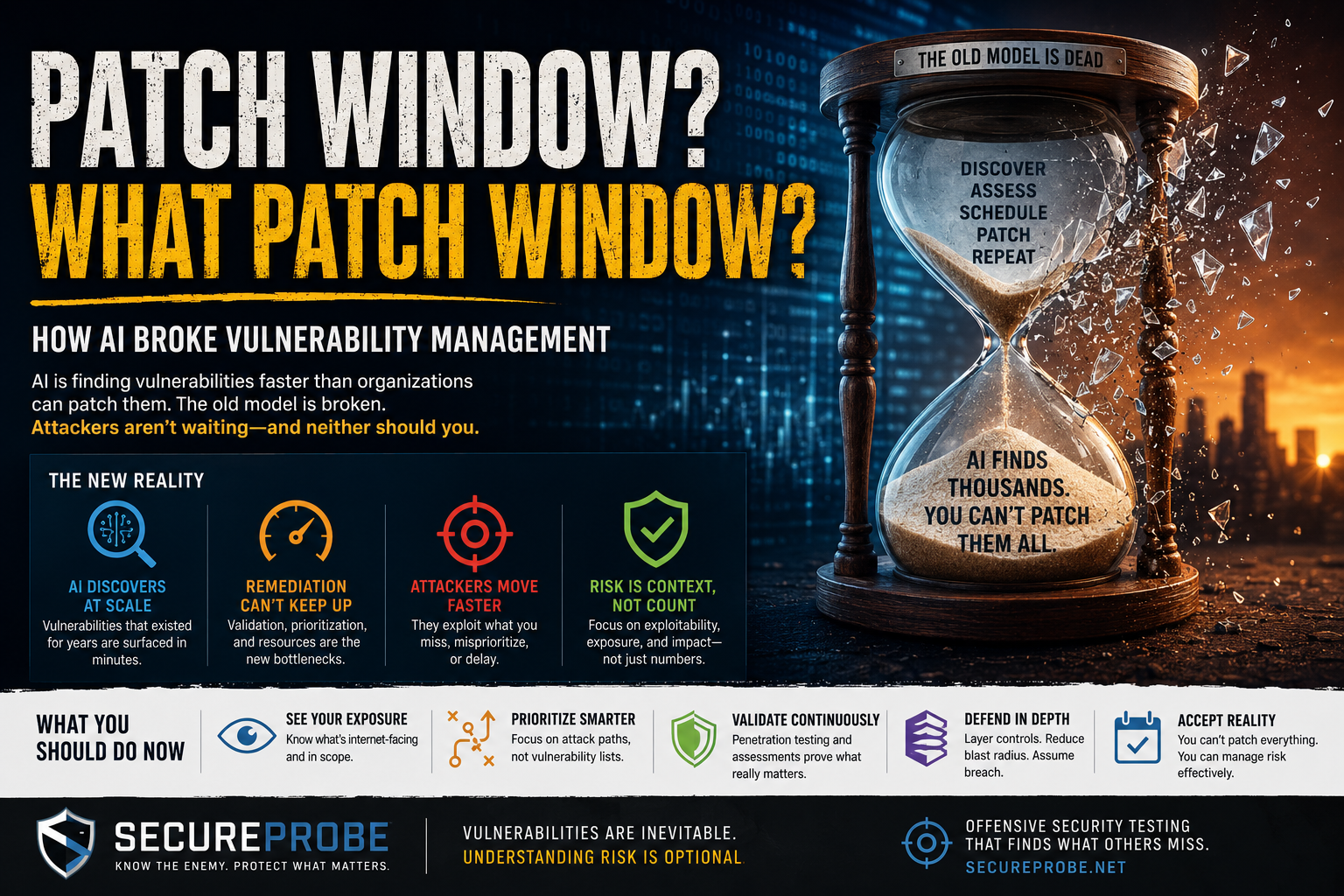
For years, cybersecurity teams operated under a relatively simple assumption: discover vulnerabilities, prioritize them, patch them, and reduce risk. The process was imperfect, but manageable. Security scanners identified issues, IT teams scheduled remediation windows, and organizations raced to stay ahead of attackers.
Key Takeaway
Security teams no longer operate in a world where discovery is the bottleneck. Remediation is.
The old vulnerability management model
Historically, vulnerability management followed a predictable cycle: vulnerabilities were discovered through scans or penetration tests, security teams assessed severity, IT scheduled patch deployment, systems were updated during maintenance windows, and risk decreased until the next scan cycle.
The approach worked reasonably well when vulnerability discovery operated at human speed. Security teams could plan around monthly patch cycles. Infrastructure teams had time to test changes. Leadership could prioritize risk according to available resources.
Today, attackers and defenders both have access to automation and AI. The pace has changed.
AI is finding problems faster than organizations can fix them
Modern AI-assisted security research is dramatically increasing the rate of vulnerability discovery. Systems capable of reviewing enormous codebases can surface issues that may have existed quietly for years.
Some vulnerabilities are critical. Others are low risk. Many turn out to be false positives. The problem is not simply finding weaknesses. The problem is validation.
When thousands of findings appear, security teams have to determine which ones actually matter. Patching every vulnerability immediately is not realistic.
Most organizations already struggle with remediation backlogs. Infrastructure dependencies, change control processes, staffing limitations, and operational risk make "patch everything immediately" impossible.
Why SMBs and mid-sized organizations feel this most
Large enterprises often maintain dedicated vulnerability management teams. Smaller organizations typically do not.
A lean IT department may already be managing endpoint protection, identity and access management, cloud administration, compliance requirements, incident response, and user support.
Adding thousands of AI-generated findings into an already overloaded workflow can create paralysis. Critical vulnerabilities compete with informational findings. Important issues wait too long. Attackers only need one.
Exploitability matters more than vulnerability count
One of the biggest mistakes organizations make is focusing exclusively on vulnerability volume. Security dashboards showing "12,000 vulnerabilities" create panic, but numbers alone rarely tell the story.
A remotely exploitable authentication bypass affecting internet-facing infrastructure deserves immediate attention. A low-risk informational finding on an isolated internal system may not.
Modern vulnerability management must answer practical questions: Is the system externally accessible? Does exploitation require authentication? Is there public exploit code available? Is the asset business critical? Can vulnerabilities be chained together?
Attackers think in attack paths. Defenders should too.
Attackers are not waiting for your next patch cycle
Threat actors do not operate on maintenance windows. They scan continuously, automate reconnaissance, and weaponize newly disclosed vulnerabilities quickly.
Organizations that rely solely on patch cycles without validation, segmentation, monitoring, and defensive layering increasingly operate at a disadvantage.
Patching remains essential. Patching alone is no longer enough.
What organizations should do now
The future of vulnerability management is not patch faster. It is prioritize smarter.
Security programs should increasingly focus on risk-based prioritization, attack surface visibility, continuous validation, defense in depth, and accepting that backlogs exist.
Perfect remediation is impossible. Smart remediation is achievable.
Final thoughts
Artificial intelligence is making vulnerability discovery faster, cheaper, and more scalable than ever before. That is both exciting and uncomfortable.
The patch window is not getting smaller. It may already be gone.
The organizations that succeed will not necessarily patch everything first. They will understand risk better than everyone else.
SecureProbe helps organizations identify and validate security weaknesses before attackers do. Vulnerabilities are inevitable. Understanding which ones matter most is where security maturity begins.
Real-World Risk
Threat actors do not operate on maintenance windows. They scan continuously, automate reconnaissance, and weaponize newly disclosed vulnerabilities quickly.
Smarter vulnerability management priorities
Related Articles
Need help validating real-world risk?
SecureProbe provides penetration testing, vulnerability assessment, and attack surface analysis services designed to identify practical security risks and provide clear remediation guidance.
Request an Assessment