Dark Web Credential Markets: How Stolen Logins Become Business Risk
For many organizations, the first sign of a breach is not a malware alert or a loud exploit. It is a valid login from an account that should never have been in an attacker's hands.

Key Takeaway
Credential theft turns ordinary usernames and passwords into a business risk because attackers can bypass the front door by simply logging in.
Why credentials are so valuable to attackers
Attackers like credentials because they look normal. A successful login with a real username and password can blend into everyday business activity better than a brute-force attack or exploit attempt.
That is why stolen logins are bought, sold, traded, and reused across criminal marketplaces and private groups. Some come from phishing. Some come from malware that steals browser passwords. Others come from third-party breaches where employees reused a work password somewhere else.
Once a credential is exposed, the attacker does not always need to hack through a technical vulnerability. They may only need to find where that login works.
What gets sold online
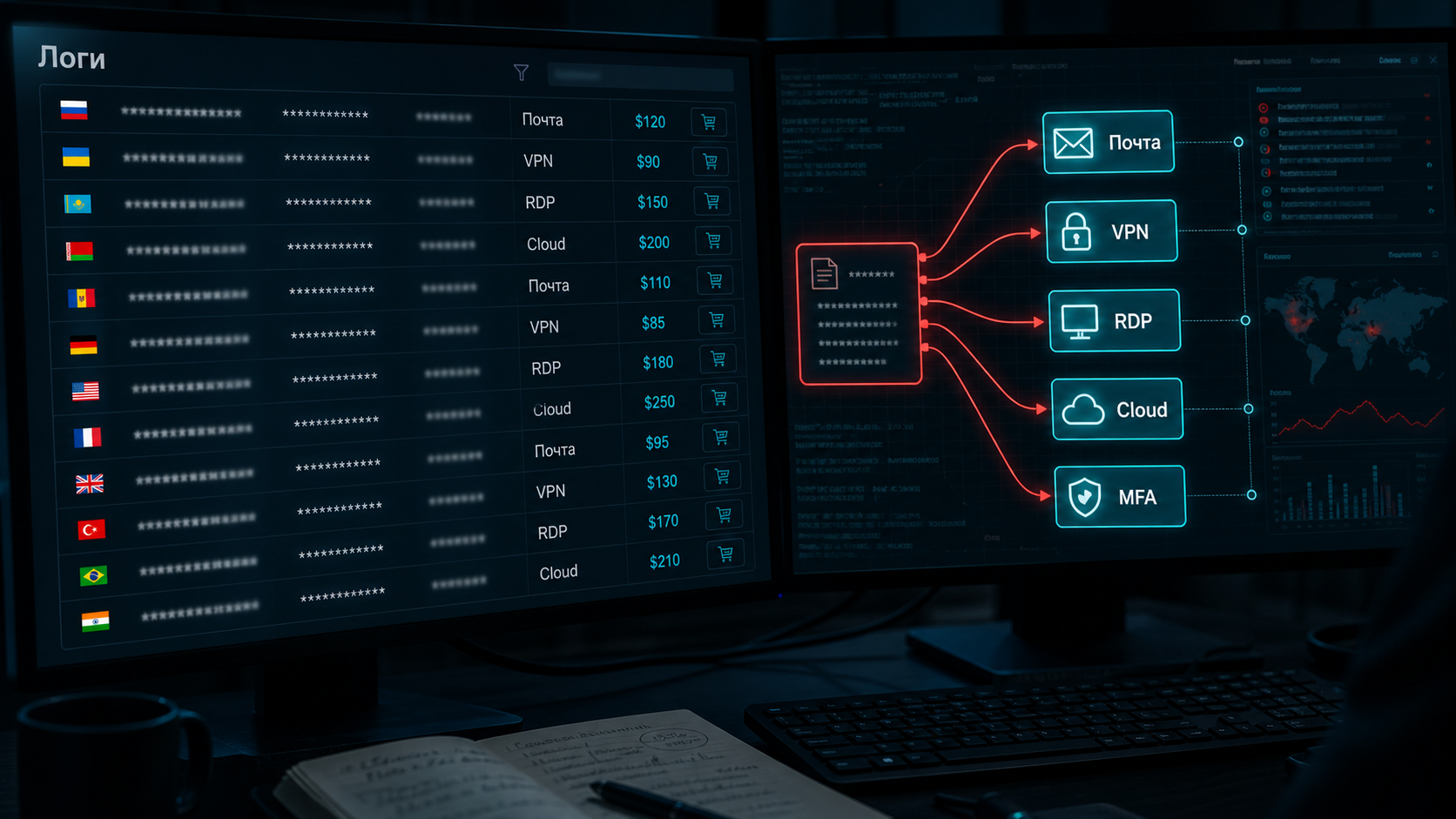
Credential markets can include email accounts, VPN logins, remote desktop access, cloud dashboards, customer portals, developer accounts, session cookies, browser fingerprints, and database access. The most dangerous listings are often the ones tied to real business systems.
Some sellers package access with extra context: company name, user role, geographic region, exposed service, or whether multi-factor authentication appears to be enabled. That context helps buyers decide which access may be useful for fraud, ransomware, data theft, or lateral movement.
For defenders, the important point is simple: your exposed login surface is part of your attack surface.
Real-world examples show how organized this market has become
Russian Market is one of the names security teams now associate with infostealer logs and stolen credential sales. Public threat intelligence reporting has described it as a major destination for credentials harvested by malware, especially after law enforcement disrupted other large credential shops.
Genesis Market is another useful example. In April 2023, the U.S. Justice Department announced an international operation against Genesis Market, describing it as a marketplace that sold account access credentials taken from malware-infected computers. Treasury also described Genesis Market as a Russia-linked marketplace that packaged usernames, passwords, device identifiers, cookies, and other victim data for sale.
xDedic showed a slightly different version of the same business problem. DOJ described it as a marketplace for compromised computer credentials where buyers could search by criteria such as price, geography, and operating system. That matters because remote access credentials are not just passwords; they can be direct paths into business infrastructure.
How stolen logins turn into intrusions
A compromised password rarely stays isolated. An attacker may try the same username and password against VPN, Microsoft 365, Google Workspace, payroll, CRM, code repositories, cloud consoles, and remote access services.
If one login works, the attacker can look for files, internal messages, saved passwords, access tokens, and administrative paths. They may create mailbox rules, register new MFA devices, invite external accounts, or use legitimate tools already present in the environment.
This is why credential exposure can become a full security incident even when no software vulnerability was exploited.
Why password reuse is still a major problem
Password reuse is one of the easiest ways a consumer breach becomes a corporate risk. If an employee uses the same password for a personal service and a company account, a breach outside your organization can still put your systems at risk.
Attackers automate this testing at scale. They do not need to know your company personally to try leaked credentials against public login pages and remote access services.
A strong password policy helps, but password policy alone is not enough. Organizations need controls that assume some credentials will eventually be exposed.
What companies should do now
Start with multi-factor authentication everywhere it matters: email, VPN, remote desktop gateways, cloud consoles, identity providers, financial systems, developer platforms, and administrator accounts. Prefer phishing-resistant MFA for privileged and high-risk users when possible.
Reduce exposed login surfaces. Disable unused remote access, remove stale accounts, enforce conditional access, restrict administration by location or device posture, and monitor for logins from unusual systems or geographies.
Companies should also use password managers, block known compromised passwords, monitor for credential exposure, rotate secrets when exposure is suspected, and review logs for impossible travel, suspicious mailbox rules, new OAuth grants, and unexpected MFA changes.
Where penetration testing and attack surface analysis help
Automated monitoring can tell you that credentials may be exposed. Attacker-focused testing helps answer what could happen next.
A good assessment looks at exposed portals, authentication controls, password policy, MFA coverage, stale accounts, cloud access, and whether a compromised user could reach sensitive systems.
The goal is not to shame users for bad passwords. The goal is to build an environment where one exposed credential does not become a breach.
Final thoughts
The dark web sounds distant, but credential risk is very close to everyday business operations. Email accounts, cloud dashboards, VPN portals, and developer tools are all valuable because they provide access attackers can use immediately.
Companies do not need perfect visibility into every criminal marketplace to improve their defenses. They need strong identity controls, reduced exposure, monitoring that catches abnormal behavior, and validation that those controls work under realistic conditions.
SecureProbe helps organizations understand where exposed services, weak identity controls, and real attack paths create practical risk. The best time to find those paths is before someone else logs in first.
Real-World Risk
Stolen credentials reduce the attacker's need for noisy exploitation. A single reused password, exposed remote access portal, or unmanaged account can become the beginning of a real intrusion.
Credential risk controls that matter
Related Articles
Need help validating real-world risk?
SecureProbe provides penetration testing, vulnerability assessment, and attack surface analysis services designed to identify practical security risks and provide clear remediation guidance.
Request an Assessment